
Miller County Probate Court Records
Miller County Probate Court sits in Room 110 at the courthouse in Colquitt. Judge Josh Suggs is listed for the local Probate Court, with the same Room 110 contact path used by the Miller Probate and Magistrate court site. The official county page says probate courts have exclusive original jurisdiction over probate of wills, administration of estates, appointment of guardians, and involuntary hospitalization of incapacitated adults and others. The same local court page also places marriage licenses, oaths, and some preliminary or traffic functions within the probate judge's possible Georgia role.
Probate records should be separated from Superior Court civil files. A will, estate administration, guardian appointment, or conservatorship matter starts with Probate Court. A divorce, adoption, major civil case, or felony case belongs with the Miller County Clerk of Superior Court. That distinction prevents wrong-office requests. Probate staff may help locate a file or explain copy steps, but the research cautions that court staff cannot give legal advice about how to file, whether a petition is sufficient, or which probate procedure fits a family situation.
Miller County Probate Court
Judge: Josh Suggs
155 South First Street, Room 110
Colquitt, GA 39837
229-758-4110
Fax: 229-758-8133
Email: millerprobate@gmail.com
Monday-Friday, 9:00 a.m.-5:00 p.m.
Miller County Probate Terms
Probate words are short labels for roles and case types. The label on the record helps identify what to ask for when searching online or calling the court. A petitioner may not be the same person as the decedent's heir. An executor may be named in a will, while an administrator may be appointed when no valid will controls the estate. Guardianship and conservatorship are often sensitive because they concern a minor or an adult who needs court-supervised help.
- Testator
- The person who made a will.
- Executor
- The person named to carry out a will after death.
- Intestate
- A death where no valid will controls the estate.
- Letters testamentary or administration
- Court papers that give authority to manage an estate.
- Guardianship
- A court case about personal care or decisions for a minor or adult.
- Conservatorship
- A court-supervised role for another person's property or finances.
Search Miller County Probate Records
The online starting point is Georgia Probate Records, a statewide portal with search tiles for estate information, recorded marriage licenses, traffic dockets, will information, guardianship petitions, death information, and hearing or traffic calendars. The portal also has a marriage application function. County participation and record coverage can vary by record type, so the portal should be paired with the local Room 110 office for older files, missing results, certified copies, and restricted matters.
The statewide Georgia Probate Records portal image assigned to Miller County shows the record categories available from the portal entry screen.
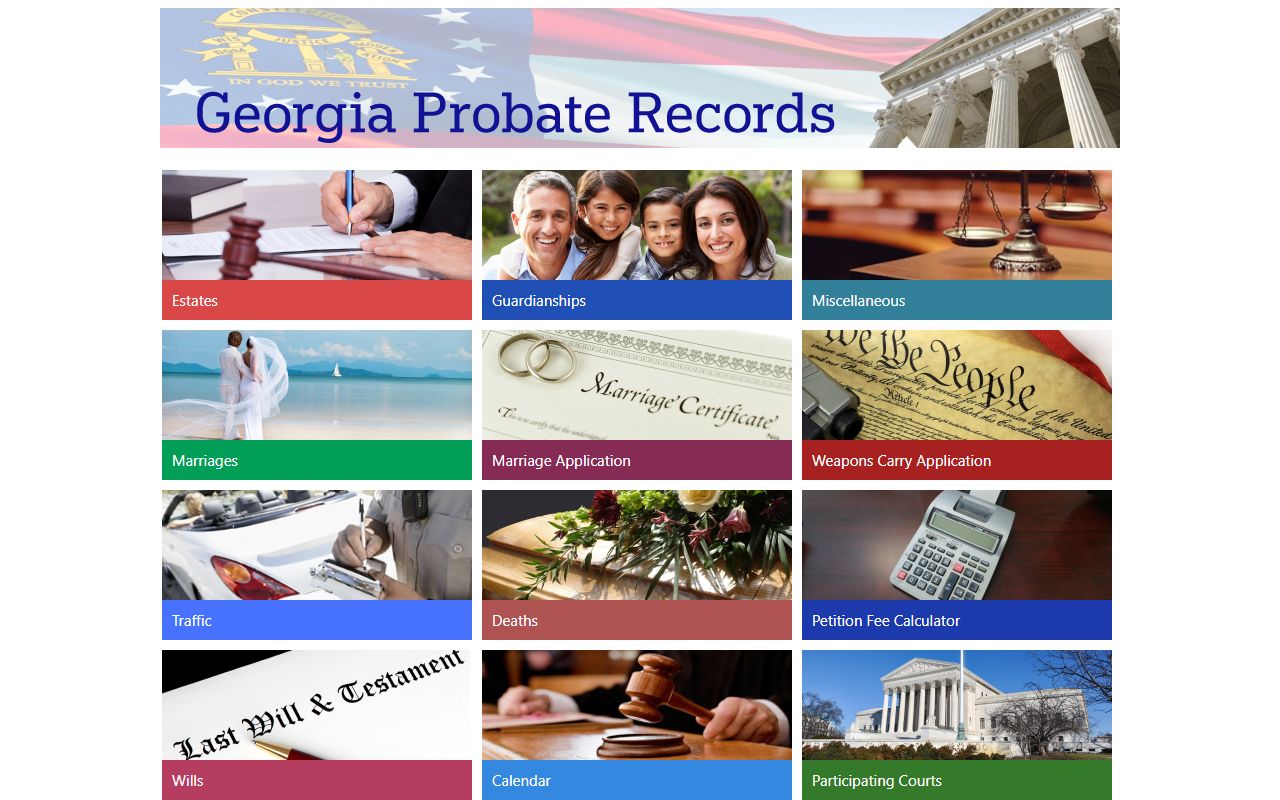
The portal layout supports a search-first approach for public entries, with the local Probate Court serving as the fallback and certified-copy source.
- Identify the record type first: estate, will, guardianship, conservatorship, death, marriage, traffic docket, or hearing calendar.
- Search the matching Georgia Probate Records tile by name, county, date, or available case details.
- If no Miller County result appears, call Room 110 with the decedent or protected person's name, filing year, date of death, petitioner, and requested copy type.
- Ask whether the file is public, restricted, archived, pending, or available only by in-person or mail request.
- Confirm copy fees and payment method before mailing a request to the courthouse.
Miller County Probate Search Fields
The statewide portal does not start with one universal case-number box. It presents record-type tiles, which matters for Miller County probate searches because a will search is not the same task as a guardianship search or a recorded marriage search. A requester who does not know the filing type should call Probate Court before trying several searches with broad names.
| Portal option | Required | Record use |
|---|---|---|
| Search Estate Information | No | Estate entries and related estate information. |
| Search Recorded Marriage Licenses | No | Recorded marriage records where available. |
| Search Traffic Dockets | No | Probate or traffic docket data where the county participates. |
| Search Will Information | No | Will record searches. |
| Search Guardianship Petitions | No | Guardianship petition searches with access limits as applicable. |
| Enter Marriage Application | No | Starts the marriage-license application process. |
| Search Death Information | No | Death information searches. |
| Hearings And Traffic Calendar | No | Calendar and hearing information. |
Miller County Probate Fees
The research located exact local fees for marriage services and noted that estate and guardianship initial fees are listed on the local Probate Court fee page but were not captured as exact amounts. That means the fixed marriage charges can be used as listed, but estate, guardianship, and certified-copy totals should be confirmed with Probate Court before filing or mailing payment. This is especially important when a filing requires service, publication, certified copies, or multiple letters.
| Fee item | Amount or status |
|---|---|
| Marriage license without premarital counseling | $77 |
| Marriage license with premarital counseling | $37 |
| Marriage certificate | $10 |
| Estate initial filing fees | Listed on local fee page. Confirm exact amount with Probate Court. |
| Guardianship initial filing fees | Listed on local fee page. Confirm exact amount with Probate Court. |
| Mailed copy or certified copy requests | Call 229-758-4110 before sending payment. |
Note: Filing fees and copy charges can change when service, certification, or extra pages are involved.
Miller County Probate Record Contents
A Miller County estate file may include the estate name, decedent, petitioner, executor or administrator, filing date, case status, letters, inventories, notices, objections, orders, and accounting filings. A will record may show the testator, filing date, named executor, and probate orders. A guardianship or conservatorship file may identify the protected person, proposed guardian, orders, accountings, and later reports, but those records can have access limits due to age, capacity, medical details, or financial data.
Georgia law supports the Probate Court role. O.C.G.A. 15-9-30 is the probate jurisdiction source cited in the research for wills, estates, letters, and related probate matters. Public access still depends on the record category. The same file can contain both public orders and restricted attachments. Sensitive identifiers should be redacted under Georgia civil filing rules when copies are released.
| Record type | Likely contents | Access caution |
|---|---|---|
| Estate administration | Petition, decedent, administrator, letters, inventory, orders. | Some attachments may be redacted. |
| Will filing | Will, testator, executor, probate order, notices. | Availability depends on filing and case status. |
| Guardianship | Petition, protected person, guardian, reports, orders. | Minor and capacity details may be restricted. |
| Conservatorship | Property authority, accountings, financial reports, orders. | Financial information may be limited. |
| Marriage and vital records crossover | Marriage license, certificate request, birth or death form path. | Certified vital records may have identity rules. |
Restricted Miller County Probate Records
Probate files are not all open in the same way. Guardianship, conservatorship, mental-health, involuntary hospitalization, adoption-related material, and records with protected identifiers can require direct court review. The county research states that Probate Court has jurisdiction over involuntary hospitalization, and those records should be expected to carry confidentiality limits. A public index result may not mean the full document package can be copied.
The local Miller County open-records form adds another practical rule: Probate and Magistrate requests go directly to that office, not to the Board of Commissioners or the county administrative clerk. For general county government records, the County Manager or County Clerk path may be right. For probate case files, marriage certificates, or guardianship records, Room 110 is the correct place to start. Older courthouse history also matters in Miller County because prior courthouses burned before the present courthouse was built, so older record availability should be verified by the custodian rather than assumed.
When a probate search is unclear, ask the court to separate public index information from restricted file contents. A clerk may be able to confirm the case name, filing year, status, or next hearing while withholding medical details, financial attachments, minor information, or sealed orders. Requesters should also say whether they need letters testamentary, letters of administration, a will copy, a guardianship order, a marriage certificate, or another specific document, because each request may have a different fee and release rule.
Older Miller County Probate Files
Older probate searches should not depend only on the statewide portal. Miller County's courthouse history includes fires before the present courthouse was built in 1977, and the research warns that older court files may require surviving books, indexes, microfilm, archived material, or direct office review. When searching for an older estate or will, provide the decedent's full name, approximate date of death, likely filing year, family name variants, and the document needed. Probate Court can then tell the requester whether the record is online, local, archived, restricted, or unavailable.
This is also why the correct office matters. A deed or lien related to an estate may be indexed through the Clerk of Superior Court or GSCCCA, while the estate administration itself belongs with Probate Court. A divorce tied to inheritance or name history remains a Superior Court file. A narrow request saves time because Room 110 can focus on probate records instead of rerouting non-probate questions.